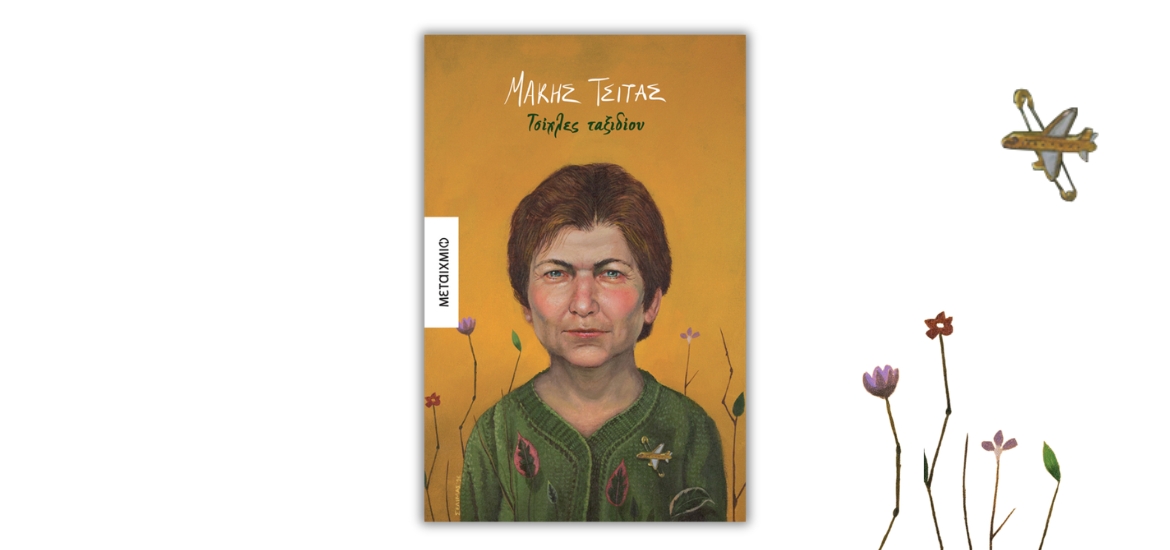
Chewing Gum for Travel
Short stories | Metaixmio Publications | 2026
Humans-saplings that try to stand upright against the livelong duration of opposing winds,
Men who come face to face with insecurity, vanity and loss.
Women who live with loneliness and despair and others who pursue utopia.
Overprotective mothers and others who are awkward or self-absorbed.
Tender, lovey-dovey grandmothers and others who are somehow misunderstood.
Sons and daughters who suffer the consequences of parental behaviour or who try to escape using understanding and forgiveness.
Nineteen stories that span some thirty years or more, each written in a different style, language and structure. With the comic or surrealistic element alternating with the dramatic and sometimes with emotion.
Critical Reviews
. . . the author uses satire and humour, which are almost non-existent in contemporary Greek literature . . . the stories cover all the aspects of our lives, which contain both laughter and tears, and the light moments as well as the difficult and even the tragic. In a simple way, we feel that they are parts of our own life from a writer who stands next to us and not opposite us. And he uses the so undervalued or badly used humour and satire which are discreet and not loud, as alas we have been accustomed to. A different road. One that others could consider taking . . .
Kostas Stoforos, Dromos tis Aristeras, 04/04/26
Makis Tsitas’ writing in Chewing Gum for Travel is people-centred, sharp and deeply moving. He manages something extraordinarily difficult: he transmutes the narrow personal into the collective, offering a work that can be read as a meditation on the human condition itself. This book is the fruit of a gaze that has trained itself to see beneath the surface of things, illuminating with acerbity and sensitivity everything that makes us human: our weaknesses, wounds and eternal attempt to find meaning in the unforeseen. With Doric wisdom, the author manages to express the pan-human amidst the momentary, leaving the reader with the feeling that life, even in its most dismal moments, remains a field of constant and deep discovery.
Agathi Georgiadou, O Anagnostis, 03/04/26
Chewing Gum for Travel is a collection of stories that demonstrate how great literature is often born from the smallest events in life and that Makis Tsitas is one of the most low-key but also the most substantial narrators of modern Greek prose, with his rare ability to transform everyday life into literature that remains, there, in the subtle crevices of reality, which often give birth to the most genuine stories. A landmark book, a jewel of a book.
Yiouli Tsakalou, Eleftheros Typos, 03/04/26
The original and exceptional plots of all these stories with their diverse contents, many upsets, unexpected consequences and pleasant or unpleasant developments, that, however, never lead to a specific and definitive end, make this entire work captivating and original and absolutely worth reading.
Stella Petridou, texnesonline.gr, 31/03/26
Tsitas observes the world – he enjoys it, wonders and philosophises about the human condition which become real in the nineteen stories in this collection. With Chewing Gum for Travel he builds a palace in forty square metres, he doesn’t spread out, he only rises up.
Nikiforos Skoumas, rise.gr, 20/03/26
Makis Tsitas’ language . . . flowing, cinematographic, alive, captivating. His tone of voice sometimes bittersweet, often mocking, subtly ironic. Whatever he describes he sees as a film, but they always give rise to second thoughts, they write in a variety of ways to your soul. From the most phenomenally insignificant event in daily life, to which the average person would pay no attention, he builds the most interesting story. There, of course, lies his linguistic mastery.
Angeliki Karapanou, Ennepe Mousa, 25/03/26
Makis Tsitas transforms the simplest moments of life into a mirror of the deepest human emotions. Observant and sensitive, he writes about social issues and, artfully, always succeeds with great sensitivity and tenderness in his treatment of serious subjects, such as the elderly, the poor, the lonely, the fragile.
Anthoula Daniel, Peri Ou, 22/03/26
Makis Tsitas’ writing, familiar and recognised, award-winning and widely read. Having gained distinction as one of the most important masters of the literary genre of the monologue narrative, whether he takes the point of view of male or female voices, Tsitas is constantly testing the limitsmo of storytelling, narrative variety, shifting styles, linguistic fluctuations to adapt to each one of the characters in his stories. In this recent collection of his tales, choosing the short form, he has also chosen a confrontation with his own succinct language.
Dioni Dimitriadou, Fractal, 17/03/26
. . . are written with such mastery that they engage even the most demanding reader: with the impeccable aesthetics of the writing and rich, realistic dialogues, his characters are depicted without sketching their opinions as a biographical reference but they become recognisable from their thoughts and actions, from their experiences and their fragility.
Dimitris Varvarigos, Peri Ou, 14/03/26
As a whole, the collection Chewing Gum for Travel shows off the power of the short story form in modern Greek prose. Through narrative economy, the importance of detail and an open structure, Makis Tsitas’ tales transform an ordinary incident into a literary event. The author’s writing confirms that literature does not always need huge stories to capture the complexity of human life. It often begins with a little moment, a brief incident or a simple gesture that will reveal the depth of the experience.
Gina Karvounaki, Literature.gr, 14/03/26
Finally, and despite the international success granted him by the excessive hero of God is My Witness, Makis Tsitas is an artist adept at the short form and he well knows how to direct it, sometimes towards the creation of enthralling children’s books and at others towards the composition of caustic literary texts with a social content. His most recent book, with the surprising title Chewing Gum for Travel, consists of such small compositions. The heroes of each story are ordinary figures, some of whom the author illuminates tenderly while he backs up some of the others with a satire of social conventions.
Manos Kontoleon, Peri Ou, 14/03/26